
Slipped, cracked or porous tiles — Old concrete tiles lose their surface coating, clay tiles crack through frost, and slates can slip as their fixing nails corrode. One missing tile can allow a surprising amount of water into the roof during driving rain.
Sykes Roofing | Leicestershire
Honest roof repairs across Leicestershire
From a single slipped tile to storm damage that has stripped the ridge clean off, we repair roofs across Leicestershire. We cover Wigston, Oadby, Hinckley, Enderby, Blaby, Leicester and the surrounding villages.
Our work includes leak detection, slipped and broken tiles, ridge re-pointing, lead flashing and valleys, chimney repairs, flat roof repairs and storm damage claims.
What sets us apart is how we find the leak. We inspect the loft and roof covering methodically, identify the actual source rather than guessing at the nearest damp patch, and explain the repair in plain English. If a repair will hold, we will tell you. If the roof needs a wider refurbishment or a full re-roof, we will tell you that too.

Start with the real problem
How roof leaks actually work, and why quick repairs fail
A lot of repair calls have one thing in common: someone has already been to the roof. A tile was swapped, a bead of sealant went on, the ceiling dried out for a fortnight, and then the same stain crept back after the next proper downpour.
That earlier repair was not necessarily careless. It may simply have been aimed at the wrong spot. Water does not enter a roof directly above the place where it appears indoors. Once it gets beneath the covering, it can travel along battens, rafters and underlay before dropping into the loft or ceiling.
The key fact is simple: water often travels before it becomes visible. A proper repair starts by tracing that route, not by treating the first wet patch as the diagnosis.
Your roof is a system, not just a covering
A pitched roof has several layers working together: tiles or slate shed the majority of the rain, the underlay catches wind-driven water, battens and fixings hold the covering in position, and leadwork protects the vulnerable joins. A repair that ignores the layer underneath can look neat while leaving the real source untouched.
Failed underlay — The felt beneath your tiles is the second line of defence. On older roofs it can split, sag or pull away at the eaves, allowing water in even when the visible roof covering looks sound.
Failed mortar bedding on ridge tiles — Ridge tiles move with temperature changes and the mortar bed eventually cracks. Frost gets into those cracks, the bond weakens, and fragments may fall onto paths or driveways after high winds.
Lead flashings and abutments — Where a roof meets a wall, chimney or another roof, lead flashing forms the weatherproof joint. It can fatigue, split at folds or pull away when the surrounding pointing fails.
Chimney stacks and flaunching — Weatherings on top of a chimney deteriorate first, followed by the pointing and the flashing around its base. Damp around a chimney breast is often connected to one of these areas.
Valley joints and drainage — Where two roof slopes meet, valley channels carry a large volume of water. Cracked mortar, damaged lead or blocked valley outlets can create persistent leaks during heavy rain.
Signs your roof needs repair
Damp patches, yellow staining or tide marks on ceilings and upstairs walls
Stains that grow after every spell of rain
Daylight visible through the roof when standing in the loft
Slipped, cracked or missing tiles, particularly after high winds
Granules of grit or sand collecting in gutters as concrete tiles break down
Black staining or thick moss growth on north-facing slopes
Crumbling pointing on the chimney stack or cracks in the flaunching
Lead flashings lifted, split or pulled away from a wall or chimney
A sagging ridge line or soft spots beneath the roof space
Water pouring over the front of the gutter rather than down the outlet
Seeing one sign does not automatically mean you need a new roof. It does mean the roof deserves a proper look. The longer water reaches the timber beneath the covering, the more likely a small repair becomes a larger and more disruptive job.
Same-day leak stop24/7 emergency call-outs
Got a leak? We make the roof safe first.
If water is coming in right now, the first job is to stop it causing more damage. We can secure exposed areas, replace dangerous loose coverings, protect openings and make the roof watertight while we assess the lasting repair.
Do not climb onto a wet roof or try to work from a ladder in high winds. Move furniture away from the drip, place a container beneath it, and turn off nearby electrical circuits if water is close to fittings. Take photographs from a safe position for your insurer, then call our emergency roof repair team.
Once the immediate risk is under control, we trace the source, check the surrounding area and provide a written explanation of what needs doing. If the leak returns before the agreed repair is finished, contact us straight away so we can review it.
Leak detection and repair
Finding the source of a leaking roof
Roof leaks are not always dramatic. Sometimes there is a steady drip; more often there is a musty smell, a brown mark that grows slowly, or damp insulation in the loft. A small amount of water over a long period can rot timber, stain plasterboard and damage insulation before the issue is obvious downstairs.
Our inspection follows the water, not the stain
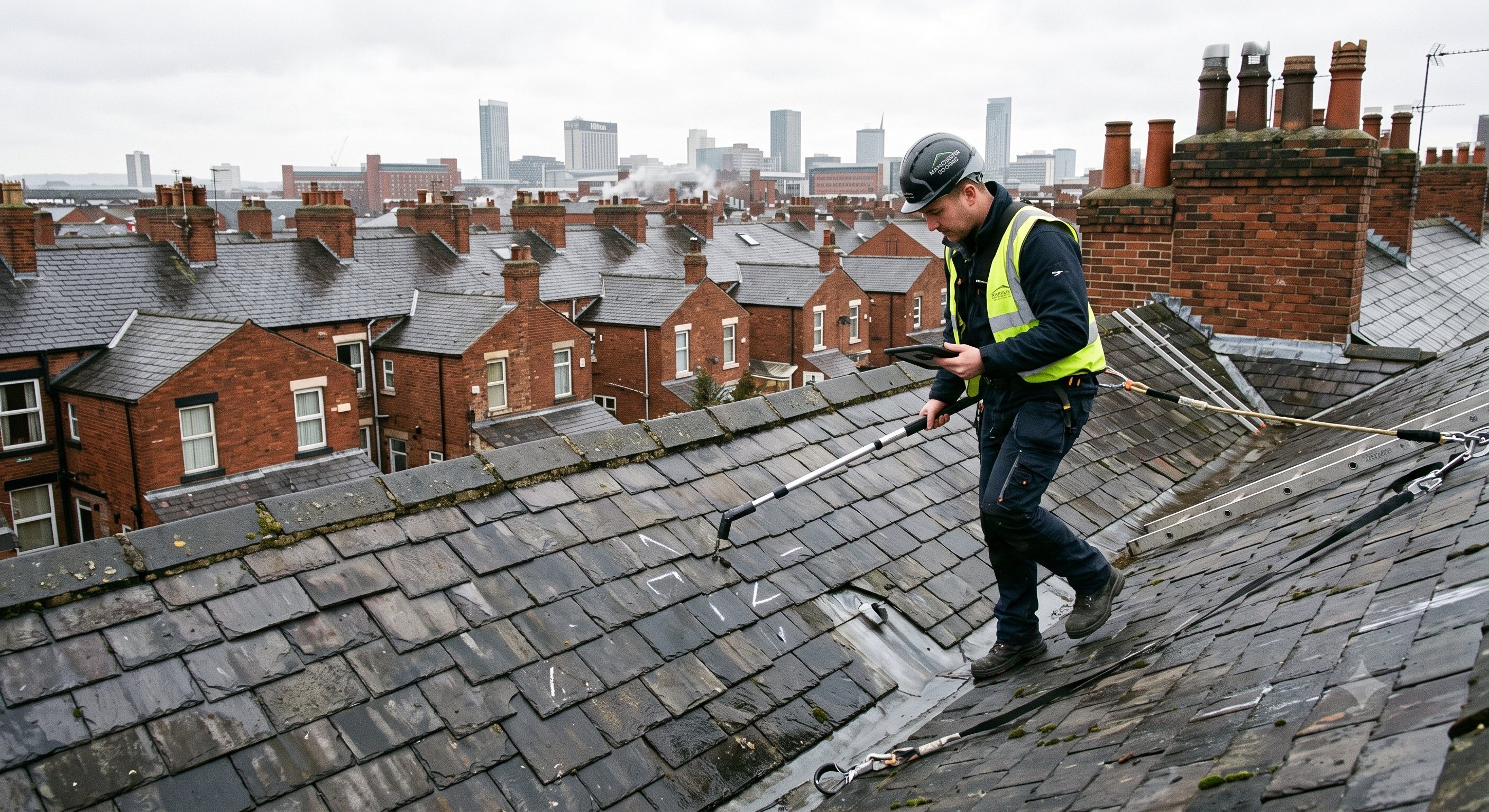
We look at the roof covering, abutments, valleys, chimneys, flashings and drainage, then compare those findings with what is visible inside the loft. We check for light gaps, wet underlay, damaged battens, nail holes, condensation and signs that water has travelled along a rafter. That process helps us separate a roof leak from condensation or plumbing, which can look similar indoors.
Once we know the cause, the repair may involve replacing tiles, renewing a section of underlay, re-bedding ridge tiles, repairing leadwork, rebuilding a valley or correcting the way water leaves the roof. We do not recommend sealant as a substitute for proper detailing where a component has failed.
A clear diagnosis matters
You receive practical advice, photographs where useful and a written quotation for the repair rather than a guess based on a ceiling mark.
Tile, slate and stone roof repairs
Missing and broken tiles
We replace slipped, cracked and missing concrete or clay tiles, using a close match wherever possible. We also check why the tile moved: wind damage, failed clips, damaged battens, a distorted roof line or a problem at the ridge can all be the underlying cause. Replacing the visible tile without checking its fixings may only postpone the next call.
Where a roof has a small area of damage, a targeted repair can be a sensible and economical solution. If tiles are porous across a whole slope or the underlay has failed, we explain that a wider repair or new tiled roof may offer better value.
Natural slate and stone slate
Slate repairs need patience and the right tools. We replace broken or missing slates, inspect surrounding fixings and take care around older roofs where the original material may be difficult to source. Stone slate roofs in particular can be heavy and irregular, so access and safe handling are part of the repair plan.
We can advise whether individual slates should be repaired, whether a section needs renewing, or whether a full slate roof installation is the more responsible long-term option.
Pitched roof details
Ridge tiles, mortar and roof edges
Ridge and hip tiles sit in exposed positions and take a great deal of weather. Cracked bedding, open joints and loose tiles can allow water in and create a safety risk below. Depending on the roof, we can carefully re-bed tiles, re-point joints, replace damaged units or recommend a mechanically fixed dry ridge or dry verge system.
The right repair depends on the age and construction of the roof. A traditional roof may need compatible mortar and careful matching, while a modern roof may benefit from a mechanically fixed detail designed to cope with movement. We assess the full run rather than treating one loose tile in isolation.
We also repair verges, abutments and roof edges, where wind-driven rain can exploit a small gap. Our lead work and roofline services can be combined with repairs when the edge detail, fascia or soffit has also deteriorated.
Lead flashing, valleys and chimney junctions
Flashing is the weatherproof bridge between the roof and anything that interrupts it: a chimney, wall, dormer, skylight or adjoining roof. Because these junctions move and collect water, they are common sources of persistent leaks. Lead can split, lift or become poorly supported; the pointing around it can crumble; and badly formed folds can hold water instead of directing it away.
We repair or renew defective leadwork, re-point abutments, check stepped and cover flashings, and inspect the valley below the tiles. Where the chimney is involved, our chimney repair service covers pointing, flaunching, pots, cowls and structural concerns as well as the flashing itself.
Good leadwork is not just about covering a gap with sealant. It needs the correct laps, clips, fixings and falls so that water is directed safely into the roof drainage system. That is why we inspect the surrounding tiles and masonry before recommending a repair.
Extensions, garages and dormers
Flat roof repairs and replacement advice
Flat roofs fail differently from pitched roofs. The common signs are blistered or split felt, standing water, loose edge trims, failed joints, damp around rooflights and water tracking back into an extension. A blocked outlet or poor fall can put constant pressure on the membrane, even when the visible damage seems minor.
We repair flat roofs where the membrane and deck remain sound, and we explain when a replacement system would be more reliable. Depending on the roof and budget, that may be high-performance felt, EPDM rubber or a seamless GRP fibreglass roof. We also check insulation, deck condition, edge trims and drainage so the new surface is not asked to compensate for a failing structure beneath it.
For garages and dormers, access is often easier than on a main roof but the consequences of a leak are still serious. Water can damage ceilings, insulation, electrics and stored belongings quickly, so early inspection is worthwhile.
Storm damage roof repairs and insurance claims
High winds can dislodge tiles, lift leadwork, damage ridge lines and send branches onto a roof. Heavy rain then finds the opening. After a storm, do not assume the roof is fine because the ceiling is dry: damage to tiles, flashings and underlay may not show indoors until the next downpour.
We can inspect the roof safely, make urgent areas watertight and document what we find. If you are claiming on buildings insurance, we can provide photographs, a written report and a clear scope of repair for your insurer. Policies differ, so we recommend checking your excess and cover before authorising non-urgent work.
Our local team serves homeowners across Huncote, Sapcote, Countesthorpe, Broughton Astley and the surrounding villages, with emergency support available around the clock.
Storm checklist
- Stay on the ground and inspect from a safe position.
- Photograph visible damage without climbing.
- Move belongings away from any internal leak.
- Call for temporary protection and a written assessment.
1. Free inspection
We listen to what you have noticed, inspect the likely causes and explain what we find.
2. Clear repair plan
You receive practical options and a written quotation for the work that is actually needed.
3. Guaranteed workmanship
We complete the repair carefully, leave the area tidy and provide guarantee details for your records.
What affects the price of a roof repair?
There is no honest one-size-fits-all price for roof repairs. The cost depends on the number and type of materials, how easy the roof is to access, whether scaffolding or specialist equipment is needed, and whether the visible defect has damaged underlay, battens, timber or insulation beneath it. A small tile replacement and a leaking valley may both be described as a “roof repair”, but they are very different jobs.
Our quotations separate the work clearly so you can understand the scope. We do not use a low headline price to get through the door and then add unexplained extras. If we find an issue that changes the work, we explain it before proceeding. Surveys and quotations are free and there is no obligation to use us.
Local roofers, local response
Roof repairs across Leicestershire
We are based in Littlethorpe and work throughout the county. Explore your local area page for more information about the property types and roofing services we cover nearby.
Straight answers
Frequently asked questions
If you cannot see your question here, call the team and we will give you practical advice.
Need a roof repair? Get an honest answer.
Call Sykes Roofing for a free survey and clear advice. Emergency call-outs are available 24/7, with no call-out fees.